The administrations of UzhNU and MSU commented on the consolidation of universities at a press conference
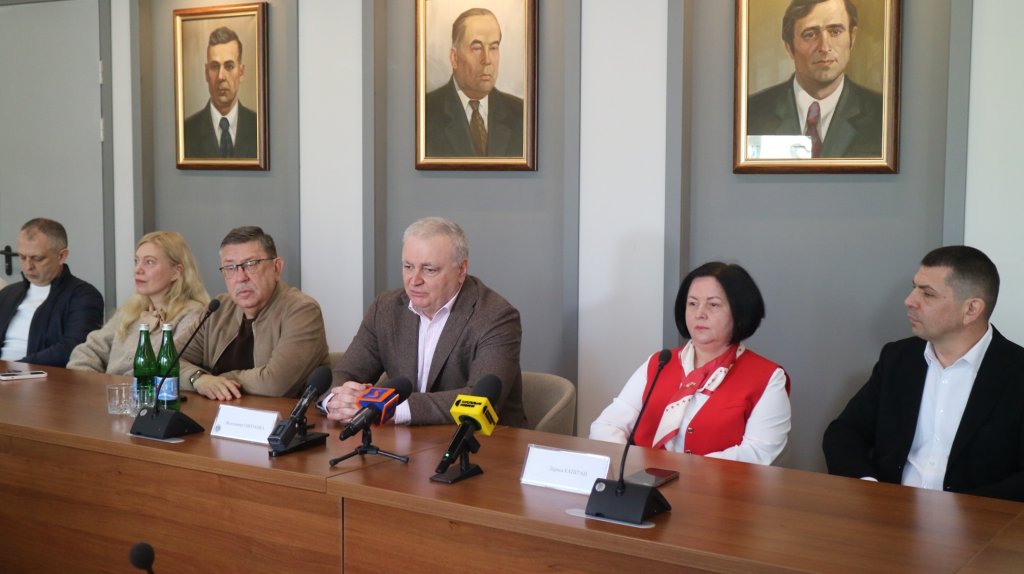
On Tuesday, March 10, the administrations of Uzhhorod National University and Mukachevo State University held a press conference for regional media in connection with the order published on the website of the Cabinet of Ministers of Ukraine on the reorganization of the two institutions. The document provides for the creation of a new legal structure — Uzhhorod University — on the basis of UzhNU and MSU.
At the beginning of the meeting, Rector Volodymyr Smolanka explained that this is part of a broader process of university consolidation that has been ongoing in Ukraine for several years. According to him, such reforms began to be implemented more actively in 2021.
The main goal is to create more powerful higher education institutions that are able to use financial resources more efficiently and compete at the international level.

“This is not a purely Ukrainian process. The consolidation of universities is taking place all over the world,” the rector noted. As an example, he cited France, where a number of large universities with tens of thousands of students have been created over the past decade. Similar processes are taking place in other European countries.
According to Volodymyr Smolanka, the merger will allow the two institutions to combine their material and technical resources, strengthen their scientific potential, and expand the range of educational programs. Students, he said, will gain access to new interdisciplinary areas of study that were not previously offered at either university.
The rector also stressed that the principle of succession will be preserved during the reorganization. This means that the property of both universities, staff, students, and educational programs will remain and continue to function within the new institution.
Volodymyr Smolanka added that the merger process is financially supported by international partners. In particular, the World Bank has provided funding for universities undergoing reorganization — approximately $1.5 million to improve their material and technical base. According to preliminary estimates, after the merger, the university will have more than 17,000 students, which will make it one of the largest higher education institutions in the country.
After the rector's speech, the acting rector of Mukachevo State University, Larysa Kapitan, took the floor. She noted that the MSU staff was involved in the discussion of the process and had the opportunity to express their position.
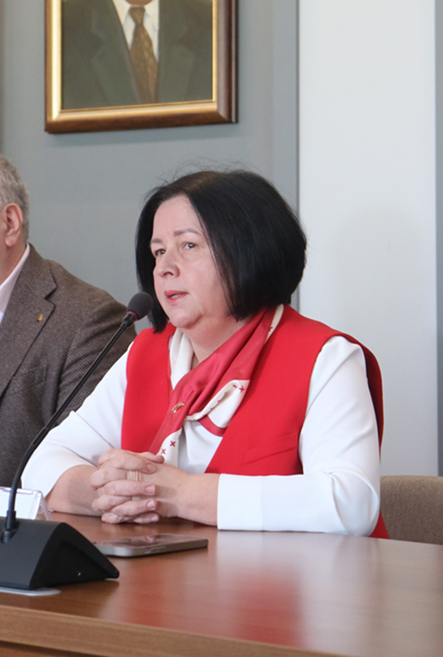
“Mukachevo State University is a team of scientific and pedagogical workers, students, and employees whose opinion is worth listening to,” she said. According to Larysa Kapitan, despite various discussions, the team understands that the optimization of the network of higher education institutions is part of state policy.
She also emphasized that cooperation between the two universities existed before: professional contacts were maintained between teachers, departments, and faculties, and many MSU graduates work at Uzhhorod University.
Separately, the head of MSU emphasized that Mukachevo University has its own human and material resources, which will strengthen the new institution. At the same time, the merger opens up opportunities for the implementation of new educational programs, including interdisciplinary ones.
According to her, the regional context is also important. Uzhhorod and Mukachevo traditionally remain the educational and cultural centers of Zakarpattia, and the development of university education in both cities will help attract students and train specialists for businesses that are actively developing in the region. "Our team is ready to work and open to new projects. I am convinced that joining forces will contribute to the development of the region, higher education, and the state," concluded Larysa Kapitan.
Larysa Kapitan also emphasized that Mukachevo State University has its own strong scientific schools, particularly in the field of pedagogy, which has been developing since the beginning of the 20th century on the basis of pedagogical education in Mukachevo. In addition, the university has experience in the economic field, particularly in marketing, accounting, and taxation.
The university is also launching new interdisciplinary educational programs, including a program in the field of cultural preservation, museum studies, and librarianship. In the future, it plans to develop this program in cooperation with specialists from Uzhhorod.

Rector Volodymyr Smolanka also emphasized that over the past ten years, the university has significantly improved its position in national rankings. "Many different events have taken place over this ten-year period. We have significantly improved our position: previously we were around 44th–46th place, and now we are 13th. There was even a year when we rose to 10th–11th place. In other words, we have significantly improved our rating,"he said. At the same time, the rector stressed that competition among Ukrainian universities is very high. “The top 20 in the ranking are extremely powerful universities in Ukraine. But we hope that we will be able to improve our position even further,” he added.
According to Volodymyr Smolanka, the practice of merging universities around the world shows that such steps can help strengthen the position of institutions. At the same time, he stressed that in the case of the merger of Uzhhorod National University and Mukachevo State University, there is no question of a “strong” and ‘weak’ university.
"I would not say that we are merging the strong and the weak. We are combining our efforts. Mukachevo State University has a number of advantages and scientific schools that are well known in Ukraine," the rector explained.
He also reminded that the university is accredited in three scientific fields: natural sciences and mathematics, medical and biomedical sciences, and social sciences. According to him, these indicators are one of the key criteria for the possibility of applying for the status of a research university in the future.
"This is the highest status of a university in Ukraine. Currently, no institution has such status. One of the criteria that works in our favor is the presence of a medical faculty,“ he said. The rector added that according to the results of the assessment, the university has high indicators in these areas, and Mukachevo State University also received positive evaluations.
Separately, he commented on the issue of the status of a ”national" university. According to him, today this status does not actually provide any additional advantages. “Currently, about fifty universities in Ukraine have national status. When this system was introduced in the 1990s, it was assumed that only a few universities would have such status and that this would distinguish them. But it turned out differently,” said the rector.
He added that when communicating with foreign colleagues, he often has to explain what the status of a “national” university means, since other countries do not have such a distinction. At the same time, according to Volodymyr Smolanka, the university plans to prepare the necessary documents to restore this status in the future after the reorganization is complete.
Rector Volodymyr Smolanka noted that the process of creating a new university will be lengthy and will take place gradually. According to him, at the first stage, the institutions will operate in the format of two campuses — Uzhhorod and Mukachevo. At the same time, in the future, the issue of forming a broader university structure will be considered, which may include separate colleges as structural units.
The rector also explained that many details of the reorganization are still being clarified. In particular, two commissions for the reorganization of universities will be created, which will be headed by the heads of the institutions. The process itself, according to preliminary estimates, may take many months — possibly up to a year.
Volodymyr Smolanka emphasized that the reorganization is primarily aimed at developing the academic environment and should not negatively affect students and teachers. All students will continue their studies, and nothing will change for them, the rector stressed.