
From water reservoir to eco-hub: international initiatives of the Botanical Garden of UzhNU

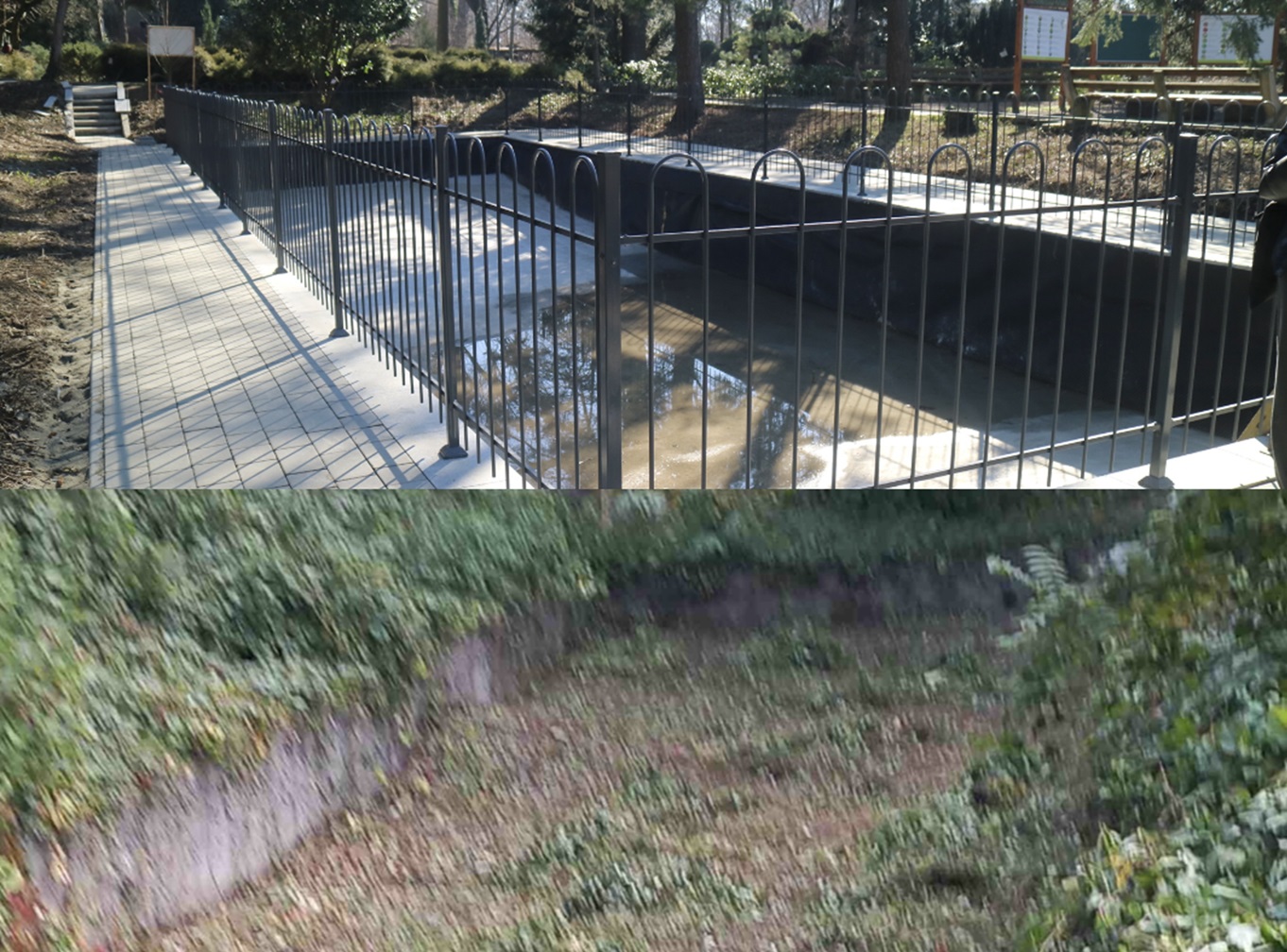
The Botanical Garden of UzhNU is completing an international grant project entitled “Water-saving solutions to mitigate the effects of climate change,” which involves the overhaul of the reservoir and the creation of a system for collecting rainwater from the roofs of garden buildings.
The project is being implemented within the framework of the Interreg NEXT Poland–Ukraine program with EU funding and co-financing from the program's participating countries. UzhNU Rector Volodymyr Smolanka came to inspect the progress of the work.
"Today we are here to assess the interim results of our activities within the international project. Work is continuing in both the old and new parts of the garden. We are also outlining further plans and prospects: what else needs to be done to ensure the project is successfully completed.
This project concerns the implementation of water-saving mechanisms and technologies in the context of climate change and global warming — to mitigate their negative effects. We are now standing next to a rainwater collection tank that will serve the entire botanical garden. This is a project aimed at the future — both for the university and the city. It is designed to bring us even closer to the community, as it involves renovating the botanical garden, making infrastructure changes, and creating special educational and natural spaces. The idea is that city residents — not just university staff and students — can come here to see and learn more about the natural wealth of Transcarpathia," said the rector.
Separately, Volodymyr Smolanka commented on an issue that has been circulating in the media in recent days — the alleged private construction on part of the botanical garden's territory.
"In 2024, when preparations for construction work began near the garden, we conducted an internal inventory to clarify its boundaries. It was found that back in 2000, when data was entered into the State Register, part of the territory was not included in the documentation for permanent land use rights. We then raised this issue, carried out all the necessary procedures, and included the plot bordering the construction site. This was done to avoid any claims — neither that construction is taking place on our land nor that we may be encroaching on someone else's territory. Thus, we have clearly defined and legally established the boundaries of the botanical garden, and no third-party construction work that is not related to its improvement is taking place here.

Project manager Oksana Stankevych-Volosianchuk emphasizes: "The construction of the rainwater storage facility has already been completed. Work on the other side of the territory, in particular landscaping, is still ahead, but this stage of the project is effectively complete.
Previously, there were concrete ruins here. There was also a pool that was filled with groundwater, which was specially pumped in. Now we collect rainwater from all the roof surfaces in the area into this pool.
There are three or four large buildings here, six collectors where the water flows, and it is piped to the pool. We will use the surplus to water plants — the water will also be stored. In fact, this is a climatically necessary solution that is currently being practiced in cities across the European Union. These are reliable approaches to rainwater management so that it remains in the city and natural areas for as long as possible and does not quickly flow into rivers and seas.
This is only the first stage. Several more pilot areas are planned here — we will implement other solutions. They will be smaller in scale, but we will experiment in the same way. A separate set of works is planned to retain water in the forest — in the second part of the underplanting on Oleg Kutsyn Street. There is a natural oak forest there, which is managed by the university. We will observe how rainwater retention measures affect soil moisture saturation and vegetation condition.
Another international project being implemented within the Interreg NEXT program at the UzhNU Botanical Garden is “Carpathian Youth for Eco-Smart Education.” Its goal is to create a modern ecological and educational environment for school and university students.
Project manager Vladyslav Mirutenko says: "This is an educational center, or, as we often call it, an eco-hub. It will be built here, on the territory of the Botanical Garden. It will be a light, modern structure with four themed halls. Each hall will have a separate exhibition dedicated to the nature, geology, and geography of the Carpathian region, in particular the Ukrainian Carpathians. We want to showcase different natural areas: the plains of Transcarpathia, mountain ranges, and the geological structure of the Carpathians. We will also talk separately about the problem of invasive species. All this will be presented through modern educational and demonstration materials — so that it is not only informative but also interesting.
At the same time, it is not just an exhibition space. We plan to actively involve students in lectures and practical classes. And, of course, schoolchildren — so that they can not only listen, but literally touch nature, gain live experience, new knowledge, and skills."
“Indeed, in recent years, the Faculty of Biology has become one of the most successful departments of UzhNU in terms of implementing international projects. We are currently implementing six projects, two of which are located in the Botanical Garden,” concluded the dean of the Faculty of Biology, Yaroslava Hasynets.


