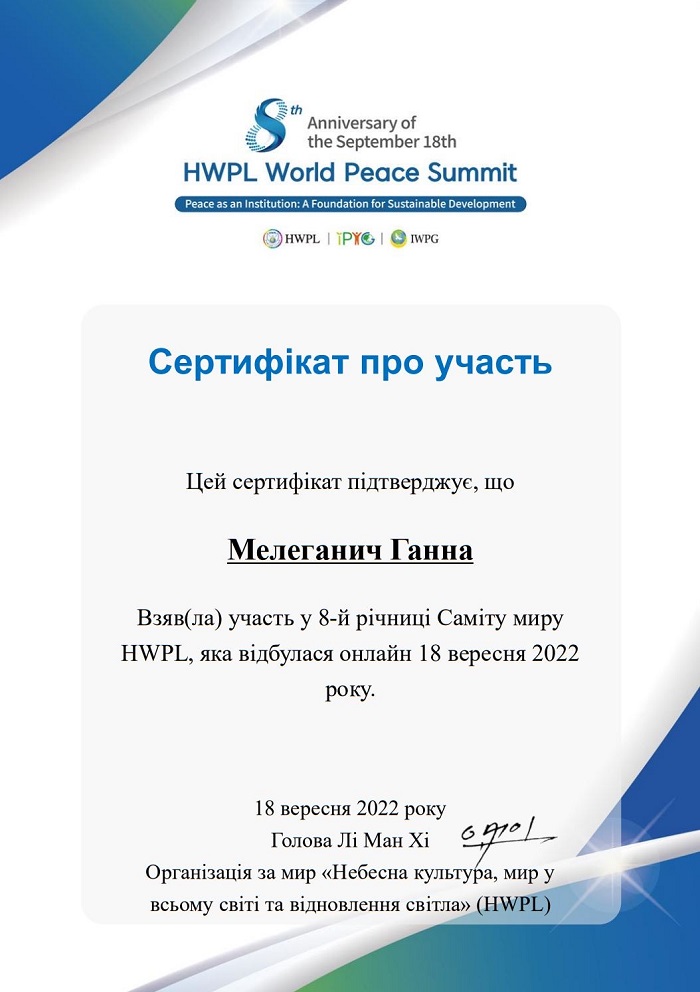
Hanna Melehanych participated in the HWPL Peace Summit

In September, Associate Professor of the Department of International Studies and Public Communications, Director of the Centre for Sustainable Development of UzhNU Hanna Melehanych took part in two large-scale international events of HWPL (Heavenly Culture, World Peace and Light Restoration) at UN ECOSOC.
In particular, on 18 September, events dedicated to the 8th anniversary of the HWPL Peace Summit on "Institutional Peace: A Framework for Sustainable Development" were held online, with 5000 people from 146 countries participating: Ukraine, the USA, Germany, South Africa, Australia, the Philippines, South Korea and others.
Given the full-scale military invasion of Ukraine, the international peacekeeping NGO Heavenly Culture, World Peace and Light Restoration (HWPL) under UN ECOSOC called on the whole world to stand in solidarity for peacebuilding at the global level.

The speakers at the event were:
- Mr Lee Man-hee, Chairman of HWPL, Korean War veteran;
- President of the National Assembly of Suriname Marinus B;
- Minister of Education, Human Resource Planning, Vocational Training and National Advantage of Dominica, Ms Octavia Alfred;
- Mahendra Das, President of the Sri Sri Radha Madhava Mandir in the Philippines;
- IPYG CEO Chong Yong Min and other honorable guests.
HWPL has proposed institutional peace to address global threats.
The main goal is to weave the values of peace into our social order. That mutual respect, harmony, cooperation and shared prosperity become part of our institutions as the norms and culture of each society, as laws within countries and international law.

The principle of peace that ensures this institutional peace is contained in the Declaration on Peace and the Cessation of Wars (DPCW). The DPCW lays the foundation for the institutionalisation of peace, the process of establishing peace in society. In its 10 articles and 38 paragraphs, the DPCW emphasises conflict prevention and resolution, mutual respect and resolution of conflicts between religious and ethnic groups, and the promotion of a culture of peace. The DPCW not only indicates "what" needs to be done for institutional peace, but also "who" should do it. From international organisations to central and local governments, non-governmental organisations and civil society groups, all members of the international community are identified as key players in the struggle to institutionalise peace.
The guests of the event spoke about the readiness of leaders of many countries to establish peace at the legislative level, the role of parliaments in peace building and conflict prevention, the institutional approach to interreligious dialogue in terms of the role of religion in promoting peace, and the role of youth as a key actor in international action. The recording is at https://www.youtube.com/watch?v=UXlB4XzQHQ4.

On 23-25 September, Hanna Melehanych also took part in a conference entitled "I want to change the world. What now?", organised in Prague by the Czech branch of the international peacekeeping organisation HWPL. The event was aimed at providing a platform for society to discuss topics related to peace and war and to draw attention to the importance of active citizenship for peace. The main programme included a presentation of the international peacekeeping organisation HWPL and its activities, lectures by witnesses of World War II, debates with war veterans and military chaplains who experienced the horrors of war , testimonies about the war in Ukraine, an environmental seminar and a talk show with influencers.


_thumb_wide.jpeg)